Keyboard test
Press a key and watch it light up. It shows keys that stay silent, keys that fire twice, and how many keys your board reads at once.
Check your keyboardArticles about the texts in the library, the people who wrote them, and the keyboards you type them on.
The same letter sits in a different place in London, Berlin, and Paris. Work out which layout is under your fingers, then switch to another without hunting through settings.
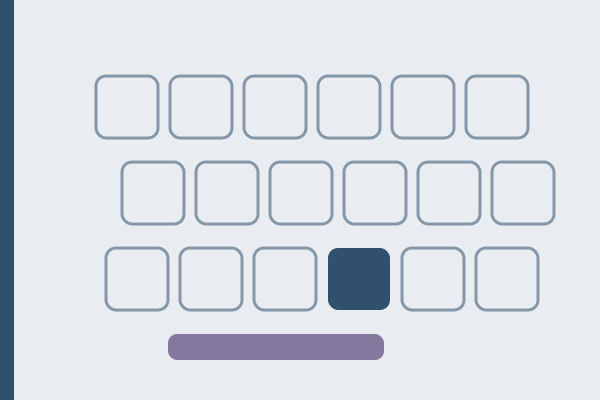 Dvorak and Colemak Compared With QWERTYColemak changes 17 keys from QWERTY, Dvorak rearranges nearly all. Home row contents, relearning cost, and when neither layout is worth it.Read the article
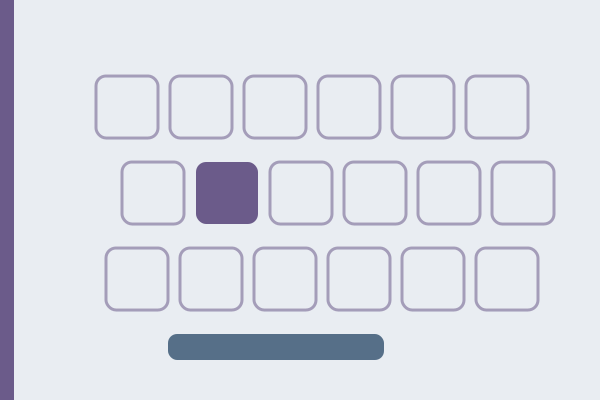 How to Change and Check the Keyboard Layout in WindowsTwo shortcuts change the layout in Windows, and one fires by accident. How to add, remove and confirm a layout before blaming the hardware.Read the article
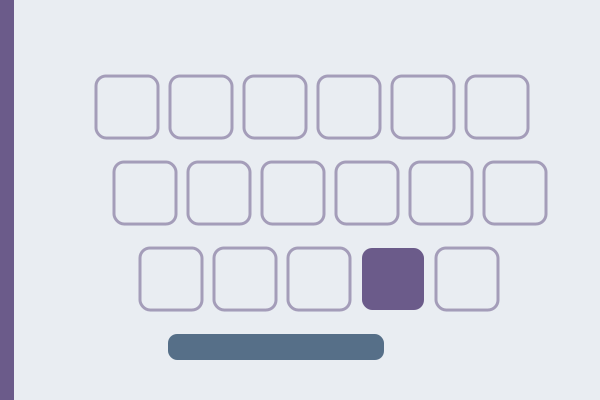 ISO or ANSI Keyboard: How to Tell Which One You HaveANSI counts 104 keys, ISO 105. Where the difference sits row by row, how to name your own board in three presses, and what it costs in keycaps.Read the article
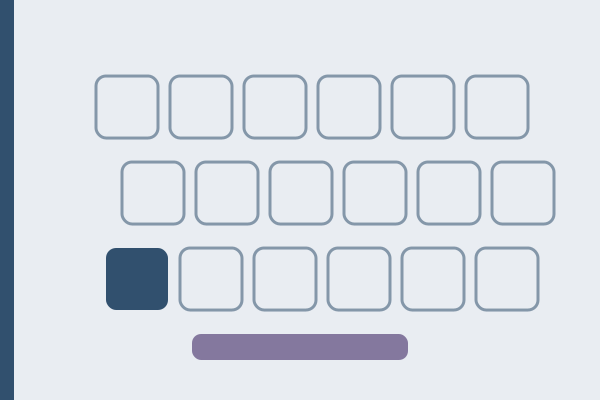 The AZERTY Keyboard Explained, Key by KeyAZERTY moves 28 of 48 character keys. Where every digit, accent and bracket sits, how Belgian AZERTY differs, and when you need the physical board at all.Read the article
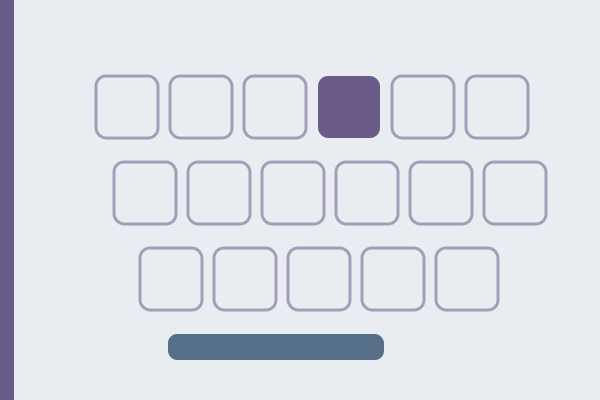 The QWERTZ Keyboard Explained, Key by KeyQWERTZ changes 24 of 48 character keys. Where ß, ä, ö, ü, @, and the brackets sit, why Y and Z swapped, and why Swiss keyboards have no ß at all.Read the article
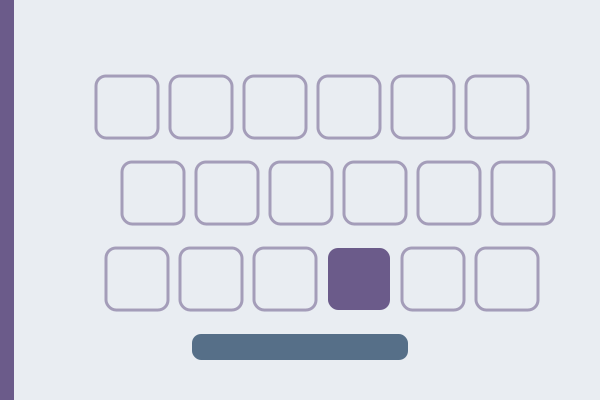 Why the QWERTY Layout Exists, and Why It StayedQWERTY reached its modern letter order in an 1878 patent. Typebar jams, telegraph operators, and why ISO/IEC 9995 standardizes positions only.Read the article
An accent takes two keystrokes, and a key that stays silent after a press is working exactly as designed. Here is the combination for your own keyboard and for a borrowed one.
 The US International Layout, and Its Five Dead KeysUS International trades five punctuation marks for accents. The dead key pairs, the space bar escape, and when plain US is better.Read the article
 What Are Dead Keys, and How to Type ê, ñ and üA dead key waits for the next keystroke before anything appears. Sequences for ê, ñ, and ü on four layouts, and the check that finds a fault.Read the article
The hand returns to the same spot after every press and the eyes stay on the text. A four-week plan, and the habits that cap your speed no matter how much you practice.
 Home Row Finger Placement, Key by KeyThe complete finger map for the home row and the rows above and below, why F and J carry bumps, and the posture faults that cost accuracy.Read the article
 How to Learn Touch Typing Without Bad HabitsHome row coordinates, one finger per key, and the measured answer to a common question: how much faster a typing course really makes you.Read the article
 Learn to Type in 30 Days, Fifteen Minutes at a TimeA four week plan with a daily length, a weekly focus and an accuracy threshold for moving on, honest about the slower first week.Read the article
 Seven Typing Habits That Quietly Cost You SpeedSeven habits that hold typing back: looking down, outrunning your accuracy, backspace overuse, one sided Shift and a chair set too high.Read the article
Two tests report two different numbers for the same pair of hands. See what each one actually counts, and which number to set against your own from a month ago.
 Average Typing Speed, and What the Number Is ForAn average of 51.56 WPM across 168,000 volunteers, 36.2 WPM on phones, and how a job requirement in KPH converts into the same unit.Read the article
 CPM and KPH, and How They Relate to WPMCPM is WPM times five, KPH is CPM times sixty. Which industries use which unit, and the four things that quietly break a comparison.Read the article
 How a Typing Speed Test Turns Keystrokes Into a NumberWhat counts as a word, when the clock starts, what backspace costs, and why the same run can be reported as 60 or as 41 words per minute.Read the article
 What WPM Means, and Why Two Tests DisagreeA word in a typing test means five characters including the space, which is why WPM measures keystrokes rather than vocabulary.Read the article
Before you take the employer’s test, run the same thing at home: the numeric keypad, the threshold to clear, and the document that comes out of it.
 The Data Entry Test, and What It Actually ScoresAlphanumeric speed, numeric keypad speed and accuracy are three separate scores in a data entry test, and each one is trained differently.Read the article
 The Ten Key Test, and How Keypad Speed Is CountedThe keypad reverses the telephone dial, marks 5 with a raised bump and reports speed in KPH. How the block is fingered and checked.Read the article
 What a Typing Assessment Test Actually MeasuresHow a recruitment typing test is scored, which roles ask for a figure, and what a WPM threshold in a job advert is really describing.Read the article
 What a Typing Certificate Proves, and What It Does NotWhat is printed on a typing certificate, what supervision changes, what a real examined credential demands, and why most employers retest anyway.Read the article
A curly brace sits further away than any letter, and that is what cuts your speed, not the language you write in. Here is where those characters live on your layout.
 Typing Brackets and Symbols on Any LayoutWhere braces, brackets, backslash, pipe and tilde sit on US ANSI, German T1 and French AZERTY, and why AltGr carries most of them.Read the article
 Typing Practice for Coding, and Why the Number DropsCode is dense in shifted characters, has no word shapes to anticipate and is edited by autocomplete, so prose WPM does not transfer.Read the article
Before you send a keyboard back or buy another one, test it in the browser: which key ignores you, which one fires twice, and how much of that a cleaning fixes.
 Ghosting, N-Key Rollover, Chatter and Double PressesGhosting, key blocking, the 6 key USB limit, chatter and double presses are four separate problems. How each one looks and how to check it.Read the article
 How to Clean a Keyboard Without Damaging ItCompressed air, keycap removal, water first and 70 percent alcohol only where the maker names it, plus what to do about a spill.Read the article
 What an Online Switch Tester Can and Cannot MeasureRegistration, repeats and event timing are measurable in a browser. Actuation force, travel distance and sound are not, whatever a page claims.Read the article
A small hand cannot reach the top row, and that is the only reason to wait. How long one session lasts, where to start, and how to tell that something has moved.
Where each passage comes from, what it meant when it was written, and what your fingers learn while you copy it out.
 The Weavers Who Made the Shepherd’s Dog BarkGeorge Eliot broke off another novel to write Silas Marner in 1861. What its opening sentence says and why it drills the hyphen key.Read the article
 What Coleridge Lost When a Visitor KnockedColeridge printed Kubla Khan in 1816 and called it a fragment. Where the dream came from, what the caller interrupted, and what the lines drill.Read the article
 What Faraday Meant by Fifteen Pounds to the InchA line from Faraday’s candle lectures, published in 1861. What he was demonstrating and what typing the passage trains.Read the article
 Why Darwin Spent a Paragraph Counting ElephantsDarwin published On the Origin of Species in 1859 and proved his point with elephants. Why the sum never touches the number row.Read the article
 Why Keats Wrote To Autumn After a September WalkWritten on September 19, 1819 after a walk near Winchester, printed in 1820. What the first stanza says and what typing it trains.Read the article
 Why Washington Never Spoke His Farewell AddressPrinted in a Philadelphia paper on September 19, 1796 and never spoken aloud by Washington. What the two practice passages train.Read the article
 Why the Constitution Begins With We the PeopleOne sentence, 52 words, agreed on September 17, 1787. Where the opening words came from and what typing them trains.Read the article
 Why the Gentlemen Are Missing From Gaskell’s CranfordCranford ran in Dickens’s magazine from 1851 and became a book in 1853. What its opening says about the missing men and what typing it drills.Read the article
Press a key and watch it light up. It shows keys that stay silent, keys that fire twice, and how many keys your board reads at once.
Check your keyboardA hundred short passages, from Lewis Carroll to the US Constitution. You type one and find out where it comes from and what it is about.
Pick a textCounting visits
We would like to count visits. Do you agree? Both tests work the same either way. Cookie policy