The AZERTY Keyboard Explained, Key by Key
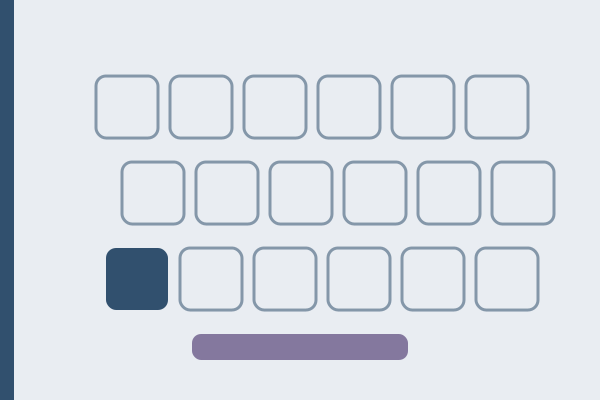
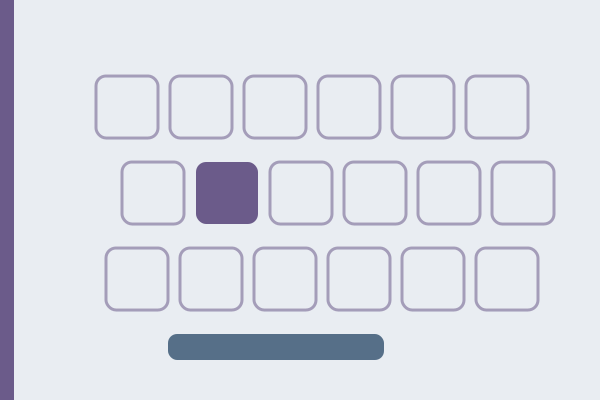
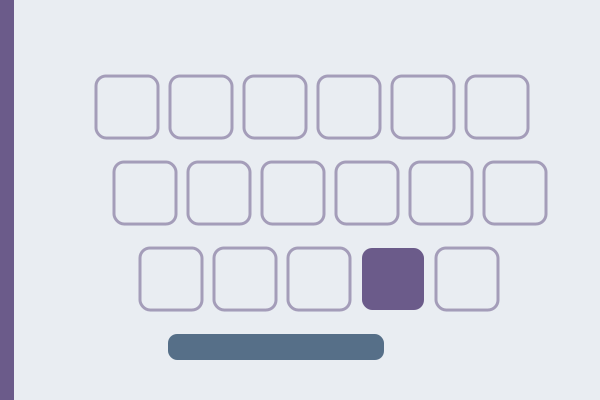
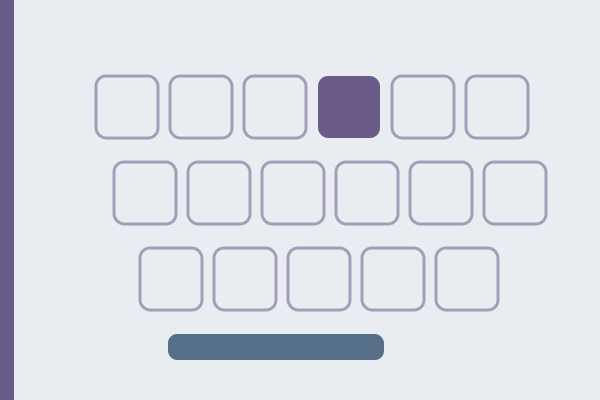
AZERTY is the keyboard family of France and Belgium, and the letter swap spelled out in its name is the smallest part of what it rearranges. Counted against the plain US layout in the data this site draws its keyboards from, 28 of the 48 character keys produce something different: five letter positions change hands, every digit retreats behind Shift, and the symbols that programmers live on move to a third level behind AltGr. The comparison above opens on that exact pair, so every difference described below can be checked on the two boards before you take our word for it.
Most articles about AZERTY stop at the letter swap and a photograph. This one walks the whole board, because the letter swap is the part you absorb in an afternoon, while the digits, the dead keys, and the missing @ are what actually interrupt people who sit down at a French machine for the first time.
What does AZERTY change in the letters?
Five letters change places. A and Q swap, Z and W swap, and M leaves its QWERTY position entirely: it lands to the right of L, on the key where US boards keep the semicolon. The key M vacated now types the comma, with the question mark on its Shift level.
| Position on a US board | AZERTY prints |
|---|---|
| Q | A |
| W | Z |
| A | Q |
| Z | W |
| M | , and ? with Shift |
| ; (right of L) | M |
Everything else in the letter block stays put. Twenty-one letters, B through Y, sit exactly where a QWERTY typist expects them, which is why reading an AZERTY board feels almost familiar and typing on one does not. A is among the most common letters in French and English alike, and it alone accounts for enough keystrokes that the first hour on AZERTY is mostly the experience of typing Q where a word needed A.
Why are the digits behind Shift?
On AZERTY the number row types punctuation and accented letters, and the digits are the shifted level. This is the single biggest structural difference from QWERTY and the one no photograph makes obvious, so here is the full row from the layout data, with the third level covered in the next section:
| Key | Unshifted | With Shift | With AltGr |
|---|---|---|---|
| 1 | & | 1 | |
| 2 | é | 2 | ~ (dead) |
| 3 | " | 3 | # |
| 4 | ' | 4 | { |
| 5 | ( | 5 | [ |
| 6 | - | 6 | | |
| 7 | è | 7 | ` (dead) |
| 8 | _ | 8 | \ |
| 9 | ç | 9 | ^ |
| 0 | à | 0 | @ |
The reason is French itself. The accented letters é, è, ç, and à appear in ordinary prose constantly, so they get the cheap, unshifted keystrokes, and the digits pay for it. A French typist writes “école” without a modifier and “2026” with four of them. One more letter lives outside the row: ù has a key of its own, two places right of L, with % on its Shift level. And the key left of 1 prints ², the superscript two used in square meters.
Whether that trade is worth it depends entirely on what you type all day. It is a real cost in spreadsheets and a real saving in prose, and it is stubborn: Windows has no setting that moves the digits down while keeping the rest of AZERTY in place, and the closest macOS comes is a French - Numerical layout that frees the digits only while Caps Lock is engaged.
Where are @, the brackets and the euro sign?
Behind AltGr, the key to the right of the space bar. QWERTY users often meet AltGr for the first time on a French board, because the US layout does not use that level at all: in the Windows layout file for US English, the right Alt is just Alt. On AZERTY it opens a third level that carries almost every symbol a URL or an email address needs.
- @ is AltGr and 0 in France. Nothing on the board advertises this, which is why “where is the at sign” is usually the first thing a visitor has to look up.
- The euro sign is AltGr and E, the same position it occupies on German boards.
- Curly braces, square brackets, backslash, pipe, and caret line up on AltGr along the digit row: { on 4, [ on 5, | on 6, \ on 8, ^ on 9, with ] and } on the two keys after 0.
- ¤, the generic currency sign, sits on AltGr under the dollar key, a leftover from the era before the euro existed.
If you need one specific character and would rather look it up than scan tables, the character finder takes a pasted symbol and answers with the exact key and modifier for each layout this site knows.
Which keys are dead on AZERTY?
A dead key prints nothing when pressed. It arms an accent and waits for the next letter, so ^ then e produces ê. The French layout has four dead marks on three keys, and the count comes from the layout file rather than from repetition of other articles, because two of the four are easy to miss:
1. The key to the right of P is the circumflex, dead. With Shift it is the diaeresis, also dead: ¨ then i gives ï. 2. AltGr and 2 arms a dead tilde for ñ and õ. 3. AltGr and 7 arms a dead grave for the rare cases the dedicated è and à keys do not cover.
The trap is that the board has a second caret. AltGr and 9 prints ^ as an ordinary spacing character, immediately, with no composing behavior, while the dead caret beside P waits for a vowel. Two keys, the same symbol on the keycap, opposite behavior. The grave accent has no such twin: it is dead on AltGr and 7, and the only way to get it as a plain character is the dead key followed by the space bar. When a key seems to do nothing, the dead keys guide shows the escape sequence and how to tell a dead key from a broken one.
Do I need an AZERTY keyboard, or just the layout?
Just the layout, in almost every case. This is the question the vendor blogs answer vaguely, so here it is without the fog: the layout is software. The operating system decides that the key left of W types q or a; the plastic only decides what is painted on top. Any keyboard becomes an AZERTY keyboard the moment the system says so, and becomes QWERTY again two keystrokes later.
What the printed keycaps change is whether you can look down and find a character you do not know by heart. That matters exactly as long as you type by looking. A touch typist never reads the caps, which is why plenty of French programmers type French on hardware printed with QWERTY, and why the reverse also works: an English speaker in Paris can switch a French machine to a US layout and ignore the paint entirely.
The honest remaining cases for matching hardware: you look at the keyboard while typing and expect to for a while, you share the machine with someone who does, or the keyboard is a laptop’s and its printed layout is what the local repair market stocks. Stickers over the caps solve the reading problem without new hardware; remapping in software solves everything else. Before deciding anything, press a few keys in the keyboard test with each layout active and watch which characters actually come out.
How is Belgian AZERTY different from French?
Belgium uses the same five letter positions as France and then quietly disagrees about the symbols. Both facts come from the Windows layout files, kbdfr and kbdbe, compared key by key:
| Character | France | Belgium |
|---|---|---|
| @ | AltGr and 0 | AltGr and 2 |
| ! | unshifted, right of the comma group | unshifted on the 8 key |
| § | Shift on the ! key | unshifted on the 6 key |
| = and + | own key left of Backspace | on the key where France puts ! |
| - and _ | - on 6, _ on 8 | together on one key before Backspace |
| £ | Shift on the $ key | Shift on the µ key |
| Dead acute ´ | not present | AltGr on the ù key |
| Dead grave ` | AltGr and 7 | AltGr on the µ key |
| Dead tilde ~ | AltGr and 2 | AltGr on the = key |
So a French typist visiting Brussels loses the at sign twice: first because it moved to AltGr and 2, then because the muscle-memory position, AltGr and 0, now produces a closing brace. The dead keys shift too. Belgium arms a dead acute, which France does not have at all, and relocates the dead grave and dead tilde from the digit row to the keys around Enter.
Windows offers three Belgian layouts: Belgian French, Belgian (Period), and Belgian (Comma). The first two are the same table under two names — one layout file serves both. The third, compared with Belgian French line by line, differs in exactly one data row: the decimal key on the numeric pad types a comma instead of a period. Every letter, symbol, and dead key is identical. The names describe who the layout is sold to, not what it does.
Is QWERTZ the same story in German?
Same genre, smaller plot. QWERTZ, the layout of Germany, Austria, and Switzerland, swaps just Y and Z, keeps the digits unshifted, and spends its right-hand keys on ü, ö, ä, and ß instead of punctuation. Its @ hides behind AltGr and Q, and two of its keys are dead. Swiss boards split by language rather than by country: the German and French Swiss layouts differ in exactly three keys, which carry ö/é, ä/à and ü/è in one order or the other, and neither has ß anywhere. Austria has no layout of its own in Windows at all; Austrian machines simply run the German one.
The family resemblance matters for one practical reason: everything this article says about layouts being software, about AltGr, and about dead keys applies to QWERTZ unchanged. Only the map is different.
What is the new French standard layout?
In 2019 France published NF Z71-300, the first official standard for French keyboards, after the culture ministry documented how hard the traditional layout makes correctly written French: capital accented letters like É and À require workarounds that most users never learn. Windows now ships the result as French (Standard, AZERTY) alongside the traditional layout, which it labels French (Legacy, AZERTY), and a third official option, French (Standard, BÉPO), an ergonomic arrangement unrelated to AZERTY. Microsoft documents the change in its globalization notes on the new AZERTY.
For a visitor the practical consequence is simple: a French machine may be running any of the three, and two of them place symbols differently from every chart printed before 2019. When the board in front of you contradicts an article, believe the board—and check it in the tester rather than in the article’s comment section.
How do I switch to AZERTY, or escape it?
Adding a layout and removing one are the same trip in every system, and no hardware is involved:
| System | Where | Quick switch |
|---|---|---|
| Windows 11 | Settings, Time and language, Language and region, add French, choose the keyboard | Windows plus Space |
| macOS | System Settings, Keyboard, Input Sources, add French | the input menu in the menu bar, or Ctrl plus Space |
| Linux (GNOME) | Settings, Keyboard, Input Sources, add French (AZERTY) | Super plus Space |
One Windows detail is worth knowing before it surprises you. Left Alt plus Shift also switches layouts, silently, and is easy to press by accident; a keyboard that suddenly types q for a has almost always had this happen to it. The Windows layout guide covers the shortcuts in both directions, plus how to remove a layout so the cycle stops passing through it.
What actually happens when you write code on AZERTY?
Every bracket and brace except the parentheses moves to the AltGr level, along with the backslash and the pipe, and the parentheses move too, just within reach: they sit unshifted on 5 and on the key right of 0. A line like if (x[i] != y) { return; } involves AltGr four times on AZERTY and not once on QWERTY. The backtick that fences code blocks in Markdown is worse than moved—it is dead, so producing one takes AltGr and 7 followed by the space bar, two keystrokes in every terminal.
French developers resolve this in three stable ways, all software: they keep AZERTY and let the muscle memory for AltGr form, which it does; they switch the layout to US for code and back for prose with the quick-switch shortcut above; or they adopt the standard layout from the previous section, which was designed with these symbols in mind. What almost none of them do is change keyboards, which is the answer to a question this article already settled.
The full symbol-by-symbol comparison across layouts, with a lookup tool, lives in the brackets and symbols guide.
FAQ
What does AZERTY stand for?
Nothing. Like QWERTY and QWERTZ, it is simply the first six letters of the top letter row read left to right, used as the family name for the whole arrangement.
Is AZERTY slower than QWERTY?
No measurement supports a fair speed verdict either way, because typing speed follows familiarity, not geometry. What the layout data does support: digits cost one extra keystroke each on AZERTY, and code symbols cost an AltGr chord. For prose in French the accented letters run cheaper than under any QWERTY workaround. The layout is a set of trades, and which side wins depends on what you type.
Does Quebec use AZERTY?
No, and articles that say otherwise have not opened the layout file. The Canadian French layout in Windows, kbdfc, is a QWERTY arrangement: Q, W, A and Z all sit in their US positions and the digits are unshifted. French-speaking Canada types French on QWERTY with accents on the right-hand keys.
How do I type é without switching to AZERTY?
Use a layout made for exactly that. US International keeps QWERTY positions and turns the apostrophe into a dead key, so ' then e gives é. On macOS, holding the e key pops up accent choices. Both cover the five French accents without relearning a single letter position.
Why was AZERTY designed this way?
Nobody can show you the design meeting. The arrangement emerged in France in the late nineteenth century among typewriter makers, and the surviving documentation is thin enough that claims about jamming type bars or deliberate slowing are retellings, not sources. The honest version is that AZERTY is QWERTY’s close descendant, adapted under pressures that were never written down.
Passages to type on an unfamiliar board
The fastest way to make a layout real is to write on it and watch where your fingers go wrong. Washington Irving opened The Sketch Book in 1820 by declaring himself fond of visiting new scenes and observing strange characters—435 characters that put four of the five relocated letters to work; only Z sits this one out. Lewis Carroll left Alice tired of sitting by her sister on the bank in 1865, 302 characters of plain prose with commas exactly where AZERTY moved the M. The first two articles of the Universal Declaration of Human Rights, adopted in 1948 and translated into more languages than any other document, run 431 characters and read the same on every keyboard that can type them. All three are in the typing test, with author, year, and source.