The Data Entry Test, and What It Actually Scores
A data entry test produces three figures that move independently: alphanumeric speed in WPM, numeric keypad speed in KPH, and accuracy as a percentage. They are reported separately because they describe separate skills, and a high figure in one column says nothing about the others.
What does a data entry test score?
Alphanumeric speed is the part that looks like an ordinary typing test. You retype visible text for a fixed period and the tool reports words per minute, where one word means five characters including the space after it. That figure describes how you move through free text fields: names, addresses, product descriptions, case notes.
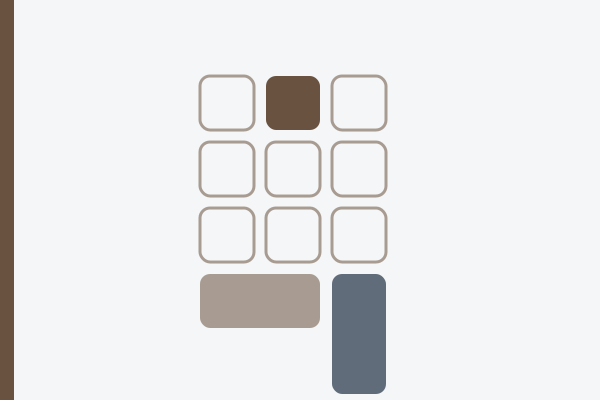
Numeric speed is measured on its own because the hands are doing something else. Digits, the decimal point and Enter sit in one block under the right hand, and the result is quoted in keystrokes per hour. Work built around invoice totals, order references or claim numbers leans on this score, and the ten key test covers how that block is trained.
Accuracy is the third figure, calculated on its own rather than folded into the speed. A run of 3,000 keystrokes at 98 percent accuracy leaves 60 wrong characters behind. In prose that is proofreading; in a column of account numbers it is 60 records that will not match anything downstream, which is why the two figures answer different questions and an advert has to say which one it screens on.
How do you turn a KPH requirement into a speed you can test?
Requirements arrive in whichever unit the department has always used, so the first step is arithmetic. KPH is characters a minute times sixty, and characters a minute is WPM times five, so the conversion is one division by 300.
| Requirement in the advert | Characters a minute | Words a minute |
|---|---|---|
| 8,000 KPH | about 133 | about 27 |
| 10,000 KPH | about 167 | about 33 |
| 12,000 KPH | 200 | 40 exactly |
| 15,000 KPH | 250 | 50 exactly |
Thresholds vary by role and employer: a figure for a transcription desk means something different on a claims queue. The arithmetic simply makes a five digit requirement legible: a steady 40 WPM already sits at 12,000 KPH. The WPM guide explains why a practice page usually shows the gross figure rather than the net one.
Which roles ask for which figure?
Occupation descriptions name the tasks, and the tasks explain which column an employer reads first. The table pairs three roles from the United States classification with their task lists.
| Role and occupation code | What the official task list names | Which score the test isolates |
|---|---|---|
| Data Entry Keyers, 43-9021 | comparing data with source documents; re-entering it in verification format | keypad KPH, accuracy scored on its own |
| Bookkeeping, Accounting and Auditing Clerks, 43-3031 | operating 10-key calculators; checking figures and postings for correct entry | numeric speed, accuracy scored on its own |
| Medical Transcriptionists, 31-9094 | transcribing dictation, telling homonyms apart in medical terms | speed against audio, not against a screen |
Two of them repay reading first. The task list for data entry keyers names a verification pass as ordinary work: accuracy is a process, not a personal trait. The one for bookkeeping, accounting and auditing clerks still names the 10-key calculator, which is why a keypad score survives in roles that no longer look clerical.
Why do errors behave differently in fields?
Your eyes stay on the source document rather than the screen. Text arrives in short bursts, each closed by Tab or Enter instead of a period, with no paragraph to look ahead in. Every field has a known shape: six digits, then a date, then a two letter code.
Errors change character too. A transposed pair inside a word is visible to anyone reading the line back; the same pair inside a reference number stays invisible until something fails to reconcile weeks later. That is why the task list treats re-entering data as a verification step, and why some employers put one record through two operators.
Keys that misbehave under speed are a separate matter: if a digit fails to appear, or appears twice from one press, the keyboard test shows repeats and missing presses directly.
Who this suits, who it does not, where to start
It suits anyone applying for work where numbers arrive from paper or a second screen: invoicing, claims, records, order desks, laboratory data. Preparation pays off because the keypad is a small, closed skill.
It does not suit a role that is mostly prose. If the advert quotes WPM and never KPH, keypad practice is a detour, and the typing test used in job applications describes the exercise you will sit.
Separate the two halves: numbers in one session, text in another. Hold accuracy where the advert puts it before letting speed move, and practice with a source document propped beside the keyboard, because working with your eyes off the screen is the habit being tested.
When the number does not mean what people think
A KPH figure without a stated accuracy is comparable to nothing: two pages can report the same 10,000 KPH while one counts corrected keystrokes and the other does not.
Keypad speed does not transfer to the number row along the top of the board, and prose speed does not transfer to fields. Our typing test runs on public domain passages over 15, 30 or 60 seconds and reports speed beside accuracy, enough to check a stated requirement before you apply. It is not an assessment an employer can verify: no certificate is issued and nobody confirms who sat at the keyboard. What such a document is worth is set out in the certificate guide.
FAQ
Is a data entry test the same as a typing test?
No. A typing test reports one speed on prose. A data entry test separates alphanumeric speed, keypad speed and accuracy, and often runs on forms with Tab between fields.
What counts as a good KPH figure?
The one printed in the advert. No external standard sets a universal threshold, and a figure quoted for one desk does not carry to another.
Can I practice the keypad without a full size keyboard?
Only partially. A board without a separate block trains the number row instead, so borrow or add a keypad if the role is numeric.
Three passages to practice the two halves on
For the accuracy half, the Preamble to the United States Constitution is unusually good material: 327 characters agreed by the Constitutional Convention in 1787, with a capital letter on almost every noun, so both little fingers share the Shift work from first word to last.
For the numeric half, Thomas Jefferson measuring the Great Miami in his Notes on the State of Virginia, 1785, gives 496 characters carrying ten numbers. The clause on seats in the first House, from the same 1787 convention, mixes thirteen state names with seat counts written out in words, from ten for Virginia down to one for Delaware. It is a capitals-and-hyphens drill rather than a numeric one: for the digit work stay with the Great Miami passage above.