Learn to Type in 30 Days, Fifteen Minutes at a Time
Fifteen minutes a day for 30 days comes to seven and a half hours of practice, which is enough time to move your typing from two fingers onto eight and not enough to make anyone fast. That is the honest scope of a month, and knowing it in advance is what keeps the fourth week from feeling like a failure.
What should you accept before the first session?
The first week will be slower than the way you type now. Hunting with two fingers is a skill you have built over years, and replacing it means going back to placing every letter deliberately. There is no version of this month that skips the dip.
Short sessions also work better than long ones. Fifteen minutes is long enough to build a habit and short enough that your hands do not stiffen, and two blocks of eight minutes are perfectly acceptable if that fits the day better. Nothing here rewards a two hour session on a Sunday.
| Week | Focus | Daily length | Threshold for moving on |
|---|---|---|---|
| 1 | A S D F, J K L and the semicolon | 10 to 15 minutes | any of those eight keys on request without looking, above 97 percent on a slow pass |
| 2 | top row first, then bottom row, three days each | 15 minutes | an easy passage typed to the end, no looking down, 97 percent or better |
| 3 | capitals, punctuation, digits from the number row | 15 to 20 minutes | a passage with mixed punctuation and capitals, cleanly, at a slow pace |
| 4 | continuous text and the first measured runs | 15 to 20 minutes | none; this week is about holding pace across a whole passage |
Speed appears nowhere in the right hand column, and that is deliberate. A figure recorded in week one measures a skill that does not exist yet.
Week one: the home row and nothing else
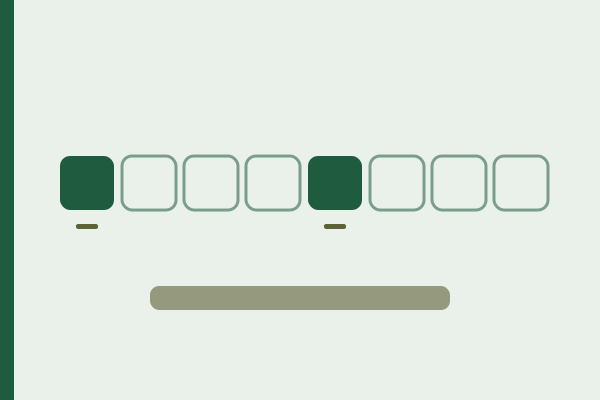
Work only on A S D F and J K L with the semicolon, with your index fingers on the tactile bumps of F and J and your thumbs resting on the space bar. Type the letters in patterns rather than words, slowly, and look at the screen instead of your hands. The full finger map is in home row finger placement.
Daily length: ten to fifteen minutes. Ignore speed completely this week, because any figure you record is a measurement of a skill you have not built yet.
Threshold for moving on: you can type any of those eight keys on request without looking down, and a slow pass over them lands above 97 percent accuracy. Most people reach that in four to six days.
Week two: the other two rows
Add the top row first, since E, I, R and U are the letters you will need soonest, then the bottom row. Introduce one row at a time and give each three days. Every reach starts from the home row and returns to it, and that return is the actual skill being trained.
Daily length: fifteen minutes. Now the corpus becomes useful, because whole easy passages ask your hands to move between rows the way real text does.
Threshold: an easy passage typed to the end, slowly, without looking down, at 97 percent accuracy or better. Speed still does not matter.
Week three: capitals, punctuation, digits
Capitals come first because they are where habits go wrong. Shift is pressed with the hand that is not typing the letter, so a capital A uses the right Shift and a capital P uses the left. Doing this the lazy way, with one Shift for everything, builds a limp that is hard to remove later, and it is one of the seven typing mistakes that cost the most.
Then punctuation: comma, period, apostrophe, question mark, semicolon. Digits last, from the home row, using the row above the letters rather than the numeric keypad.
Daily length: fifteen to twenty minutes. Threshold: a passage with mixed punctuation and capitals typed cleanly at a slow pace.
Week four: how do you take the first honest measurement?
Now type whole passages without stopping, and take a measurement at 30 or 60 seconds two or three times a week rather than every day. Our typing test records the pace, the accuracy and the number of corrections you made, and it is the last figure that tells you the most in this week.
Daily length: fifteen to twenty minutes, split between one measured run and a longer unmeasured one. Vary the passage every session, because typing the same text twice trains the text.
What to expect: the point where touch typing overtakes your old two finger speed arrives at different times for different people, and for some it is a few days after the month ends. Reaching it is a matter of hours accumulated, not of effort applied.
Who this plan is for, and where to start
Yes, follow it if you type with two to four fingers, hunt for keys, and can genuinely clear fifteen minutes a day. The plan supplies the order, which is the part nobody arranges well for themselves.
No, skip weeks one to three if you already touch type at a steady pace. Your work is elsewhere: evenness, punctuation and the habits described in seven typing mistakes. Redoing the home row will not move a figure that has stopped for other reasons.
Where to start: take one measurement before you change anything. A full length run in the typing test, noted with pace and accuracy. Without that starting value the comparison at the end of the month runs against a memory, and memory always says the old way was fine.
When 30 days is the wrong frame
- When a dated test is waiting. Four weeks covers the method, not a pace on demand. What actually helps in the week before an assessment is a different question.
- When you read the plan as a promise about numbers. It is an order of operations. Some people spend ten days on week two and some five, and both arrive at the same place.
- When practice is irregular. Two hours on a Sunday does not replace seven sessions of fifteen minutes, because motor patterns settle through repetition rather than duration.
- When you are practicing in pain. Aching wrists mean the chair, the desk height or the wrist angle is wrong, and no amount of drilling corrects a posture problem.
- When you skip a threshold. Moving to the next row before the previous one is automatic means hunting on two rows instead of one. The wider method behind these thresholds is in learn touch typing.
FAQ
Can you really learn to type in 30 days?
You can learn the finger map and stop looking down, at fifteen minutes a day. You cannot become fast; that takes months and arrives largely through ordinary typing rather than through practice. Seven and a half hours is the honest scope of the month.
How long should each session be?
Fifteen minutes, and two blocks of eight are fine if that fits the day better. Long enough to build a habit, short enough that the hands do not stiffen. Nothing in the plan rewards a two hour session on a Sunday.
When do I move to the next week?
At the accuracy threshold, not after seven days. Week one ends when you can produce any of the eight home row keys on request without looking and a slow pass lands above 97 percent. Most people reach that in four to six days; some need ten, and that is the same result.
Why is week one slower than my current typing?
Because hunting with two fingers is a skill you built over years, and replacing it means placing every letter deliberately again. There is no version of this month that skips the dip. It lasts roughly a week.
For your first passage in week two, take William Wordsworth’s I wandered lonely as a Cloud, which he printed in 1807 and expanded years later. It is built almost entirely from short common words, which is exactly what a hand still learning the rows needs, and its 412 characters are short enough to type twice in one sitting without rushing. If that still feels like a lot, Beatrix Potter’s old mouse from The Tale of Peter Rabbit of 1902 is 269 characters in four plain sentences. Keep Washington Irving’s page on going into the country, from The Sketch Book of 1820, for week three: 499 characters strung together with semicolons, which is the whole punctuation week in one passage. All three are waiting in the typing test, each with its author, year and source on its own page.