Human Rights Declaration, Articles 1 and 2
You are typing on the on-screen keyboard. Tap the text to open it and begin.
Caps Lock is on. Every letter comes out capital, so the test counts it as a mistake.
Or simply start typing.
- Time so far
- 0
- Words per minute
- 0
- Accuracy
- 100%
Done. The text and your result
0 % of characters hit
Where you slip most often
Darker keys collected more mistakes in this run.
What slowed you down
The characters your finger missed most often.
Your recent results
Words per minute across your recent runs in this language.
What to type next
 ExercisesHuman Rights Declaration, Article 23 on workUnited Nations General Assembly, published 1948The three opening clauses of the article on work, equal pay, and fair remuneration.hard456 characters
 Law and constitutionsBill of Rights: the First AmendmentUnited States Congress, published 1791The article that covers religion, speech, the press, assembly, and petition in a single sentence.medium272 characters
 ProseLittle Women, the gray dawn of ChristmasLouisa May Alcott, published 1868Jo wakes early on Christmas morning and finds the gift her mother promised.easy363 characters
The General Assembly adopted the declaration in Paris on December 10, 1948, with forty-eight states in favor and eight abstaining. A drafting committee chaired by Eleanor Roosevelt worked on the text for two years. Article one puts dignity and reason first, and article two rules out distinctions of any kind. The declaration holds the record as the most translated document in the world.
Where this text comes fromThe declaration was written by a committee, which usually shows, and here it does not. Eight states abstained rather than vote against, among them South Africa and the Soviet bloc, so the document passed in Paris without a single opposing vote. The two articles you copy are the foundation the other twenty-eight rest on: one asserts that dignity and reason come with being born, the other closes every door through which a distinction might be smuggled back in. The edition linked below carries the full English text as adopted.
What you might not noticeThe list of forbidden grounds in article two spells colour the British way, and it runs to nine items before the sentence closes, from race at the front to birth or other status at the end. Source
What it trainsTen commas in 431 characters and only five capital letters, so most of this is plain letter work. One digit interrupts it: the heading Article 2 runs straight on inside the third sentence, with no line break to warn you, so the hand goes up to the number row once and comes back down. That third sentence then carries eight of the ten commas in one list of grounds, forty-one words without a full stop. Three sentences average twenty-four words and sit in the same flat register, which is where attention slips. Three words tie for longest at eleven letters: brotherhood, which closes the second sentence, then Declaration and distinction in the third.
From our blogHow to Learn Touch Typing Without Bad Habits
Public domain status: an official document, outside copyright protection. Official reference: UN General Assembly resolution 217 A, 10 December 1948. public domain, Wikisource
More texts in this category
Law and constitutionsBill of Rights: the First AmendmentUnited States Congress, published 1791The article that covers religion, speech, the press, assembly, and petition in a single sentence.medium272 characters
 Law and constitutionsBill of Rights: the Fourth AmendmentUnited States Congress, published 1791The rule that searches need probable cause and a warrant naming the place and the things.hard332 characters
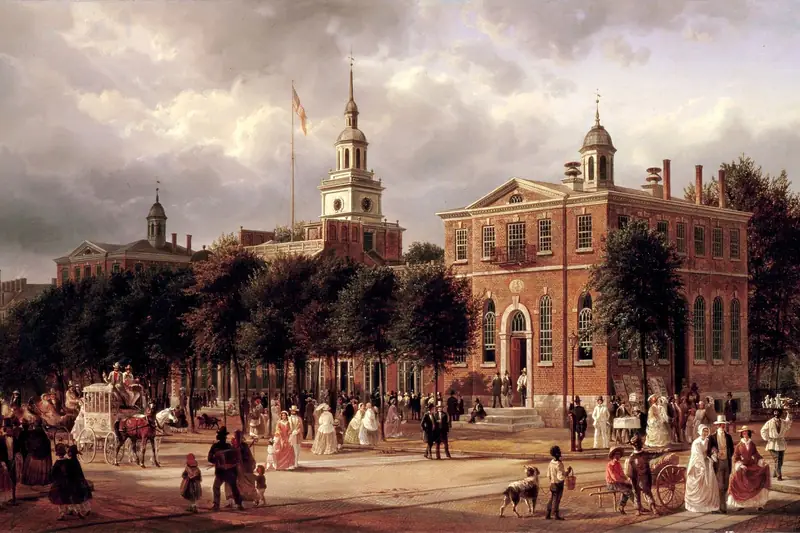 Law and constitutionsDeclaration of Independence: unalienable rightsSecond Continental Congress, published 1776The single sentence on equality and unalienable rights that the whole document rests on.hard212 characters
Law and constitutionsMagna Carta: the liberties of the citiesKing John of England, published 1215The clause granting London and every other town and port their ancient liberties and free customs.medium242 characters
Law and constitutionsDeclaration of Independence: unalienable rightsSecond Continental Congress, published 1776The single sentence on equality and unalienable rights that the whole document rests on.hard212 characters
Law and constitutionsMagna Carta: the liberties of the citiesKing John of England, published 1215The clause granting London and every other town and port their ancient liberties and free customs.medium242 characters
 Law and constitutionsUS Constitution, Article III: the courtsConstitutional Convention, published 1787The clause that creates the Supreme Court and protects the standing of judges.hard405 characters
 Law and constitutionsUS Constitution, Article VI: the supreme lawConstitutional Convention, published 1787The supremacy clause, binding judges in every state to the Constitution, federal law, and treaties.medium359 characters